
Breaking Barriers: The Roland Butcher Story In Print
John AaronNews October 2, 2025 admin

By John L. Aaron
He may not be a household name among the current crop of T20 players drawn to leagues like the IPL, CPL, BBL, PSL, and other fast-paced versions of franchise cricket. However, for those drawn to Test cricket and the classical flair of batsmen wielding willows or bowlers with the guile of Lance Gibbs or Shane Warne, the name Roland Butcher may ring a bell. He is the Barbadian-born cousin of the late West Indies Test batsman Basil Butcher, and the first black cricketer to represent England at the sport.
Being born in a small Caribbean island and going on to represent the West Indies in cricket is not uncommon. Many legendary Barbadian cricketers have taken this path, including Sir Frank Worrell, Sir Garry Sobers, Sir Conrad Hunte, Sir Desmond Haynes, Sir Everton Weekes, Sir Wesley Hall, Sir Charles Griffith, and Sir Gordon Greenidge. Each player proudly adds the Royal title of Sir to their names.

Like those knighted above, several other West Indian cricketers have been recognized by the British aristocracy for their invaluable contributions to the sport, though born far from Windsor Castle on the banks of the River Thames, but closer to Sam Lord’s Castle in Barbados, and Edinburgh or Struan castles in Jamaica, Roland Butcher, was born in the sugar cane plantation area of Saint Philip’s Parish in Barbados, and did not represent his homeland. Instead, his cricket path saw him representing the land of his country’s former colonial master, some 4,000 miles away. His uncanny journey is documented in his recent autobiography, Roland Butcher’s “Breaking Barriers – Barbados to England…and Back.”
Roland Butcher’s unplanned journey from the small island nation of Barbados at fourteen years of age to representing England at Test cricket is remarkable in itself; however, it is even more amazing that he’s the first black cricketer to represent England at Test cricket.
It’s indeed an astonishing feat when one draws a parallel between the Windrush era of 1948 to 1971, when England needed as much help as possible rebuilding the nation after World War II. The color of one’s skin did not matter then, but the muscles and brain power of so many Caribbean nationals were needed, and England leaned back on its former colonies to lend a helping hand.

The sport of cricket was certainly not one of the areas England sought to include non-Europeans to represent them at the gentlemen’s sport, more so a black man. Being the first black in anything is considered a remarkable achievement in a world dominated by former colonizers.
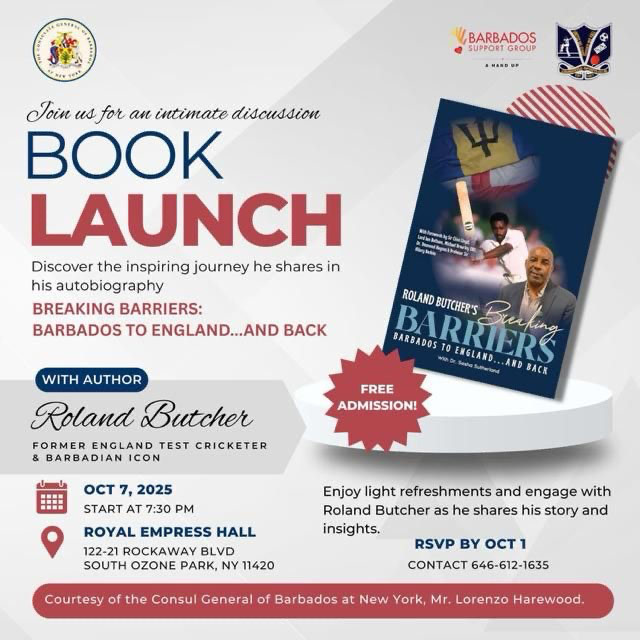
On Tuesday, October 7, cricket stakeholders and cricketers will have a chance to listen to the remarkable journey of Roland Butcher at a book signing event in New York at the Royal Empress Hall, 122-21 Rockaway Boulevard, South Ozone Park, Queens. Roland Butcher will be there in person, signing copies of his book – Breaking Barriers – Barbados to England…and Back. The event starts promptly at 7:30 pm. Admission is FREE, and the event is hosted by the Consul General of Barbados in New York.
Roland Butcher will be inducted into the Cricket Hall of Fame in Hartford, CT, on Saturday, October 4, before traveling to New York for the book-signing event, where 2012 Cricket Hall of Fame inductee John Aaron will moderate a Q&A session with the author. Mr. Butcher will undoubtedly share his experience being the first black to represent England at Test cricket in 1980 and his tenure with Middlesex County Cricket Club (1974-1999).